Drywall & Plaster Repair in Covington, Kentucky
Cracks, holes, stains and plaster that has let go. We cut out what is bad, patch what is left, and hand the wall back ready for paint. Covington and Northern Kentucky.
Tell us what is wrong
Questions we get asked first
Can you patch old plaster, or does the whole wall have to come out?
Most of the time we patch. Plaster that is still tight to the lath can take a repair around a crack or a hole and stay in the wall for decades more. We replace a section only when it has gone loose, crumbled or soaked through. We press, tap and look before we tell you which one you have.
How do you work on a stairwell ceiling that is two stories up?
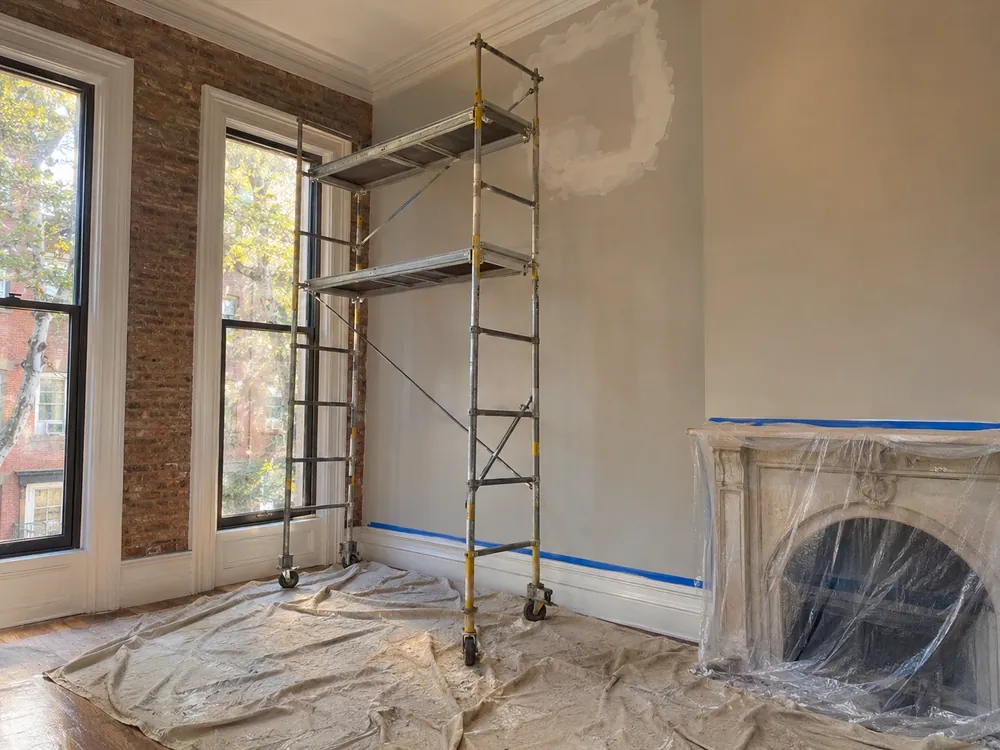
From a proper platform, not a ladder propped on the stairs. Stairwell work means staging that sits level on a sloped floor, a second person on the ground, and floors covered all the way down. If the job needs more setup than that, we tell you before we start.
The stain came back after we painted over it. Why?
Because the water source was never fixed, or the wet board was never cut out, or the paint was a plain latex that lets tannin and rust bleed through. We find the source first, cut out soft material, let it dry, then seal the spot with a stain-blocking primer before any finish coat.
Do you work in rental buildings with tenants living there?
Yes. We set a time with the tenant, keep to it, and cover their floors and furniture like we would our own. Landlords tell us which units, we send back a short note on what was done. Occupied units get a clean room at the end of each visit.
Will the patch match the walls around it?
It will be flat, smooth and sanded to the wall beside it. Old walls are rarely dead flat, so we feather the edges wide to follow the wall rather than fight it. Paint color and sheen are the painter's call. We prime so the patch does not flash through the finish coat.
What if there is mold behind the stain?
We do not test for mold and we do not remediate it. If a stain smells musty, spreads in a ring, or sits over a leak that ran for weeks, have a qualified specialist look at it. After that, we cut out the wet or damaged drywall and rebuild the wall.
How a job runs
We are a drywall and plaster repair crew. Small outfit, plain methods. A call comes in, we look at the wall, we tell you what it needs, and we do that. Nothing added to the list once we are in your house.
Covington has a lot of old walls and a lot of tall ones. That shapes how we work: we protect woodwork that cannot be replaced, we keep dust inside the room, and we do not rush coats that need time to dry.
- Look. We work out why the wall failed before we touch it. A crack from a settling corner is not the same as a crack from loose lath. A stain needs its source found first.
- Protect. Floors get covered. Original trim and stair rails get wrapped. Doorways get sealed with plastic where dust would travel to the next room.
- Cut and set. Loose or wet material comes out. Edges get cleaned. The patch goes in with the right material for the wall: plaster-compatible compound on plaster, board and tape on drywall.
- Finish. Thin coats, sanded between. Then prime, sweep, vacuum, and leave a surface a painter can use the next morning.
What we fix
Covington walls come with a past
Covington was incorporated as a town in 1815. It sits on the Ohio River at the mouth of the Licking, directly across from Cincinnati. It is in Kenton County. A few facts, and what each one does to a wall or a ceiling:
Many German families settled here in the mid-1800s.
Neighborhoods like Mutter Gottes and MainStrasse grew out of that. The National Register paperwork describes the West Side as a large, intact block of late 19th-century housing. Houses of that age were commonly plastered over wood lath, so patches need to bond to plaster, not just to board.
The median home was built around 1947, and roughly four in ten before 1940.
That is a lot of old wiring, old plumbing and old plaster. Every update run through a wall leaves an opening someone has to close.
Seminary Square and Licking Riverside are listed historic districts.
Seminary Square's listing names Second Empire, Italianate and Federal styles. Licking Riverside has been on the National Register since 1975. Rooms in homes like these often carry original trim and plaster moldings, and we cut around them.
Close to half the homes are rented.
About 48 percent of Covington housing is renter-occupied. Turnovers, shared walls and upstairs bathrooms over someone else's ceiling are everyday work here.
The Ohio Valley is wet and humid in summer and freezes in winter.
Roof and gutter water finds its way to ceilings. Old windows leak at the sills. Walls and ceilings take the stains.
Fix it now, or let it wait
Call this week
- A stain that is growing, or a ceiling that feels damp.
- A ceiling that sags, bulges or drops flakes in sheets.
- Plaster that moves or sounds hollow when you press it.
- A crack that is wider than last month.
- A musty smell near a stain. Have a specialist check it, then call us.
Can wait for a good day
- Hairline cracks that have not changed in a year.
- A nail pop or two, and small dents.
- A dry stain with a clean ring that has not moved.
- Scuffs, doorknob dents and old anchor holes.
Where we work
We work in Covington's neighborhoods and the Northern Kentucky towns around it. ZIP codes 41011, 41014 and 41016 are home ground. Each place gets its own line on the coverage page.
- MainStrasse
- Licking Riverside
- Mutter Gottes
- Seminary Square
- Westside
- Wallace Woods
- Latonia
- Newport
- Ludlow
- Park Hills
- Fort Wright
- Fort Mitchell
- Bellevue
- Taylor Mill
- Erlanger
Calls we take most
The crack climbing the stairwell
It starts at the landing and runs up the wall toward the ceiling, a little longer every winter. Plaster expands and contracts with the house. We open the crack, bridge it, and build it back flat. A crack that keeps moving gets a flexible repair, and we say if the cause needs someone else.
The stain under the upstairs bath
A brown ring on the ceiling below the tub. The painter before us rolled over it twice and it came back. We look for the leak, cut out the soft board, let it dry, seal it and patch it. If the pipe is still dripping, the plumber comes first.
The turnover due Friday
A tenant moved out, the walls have holes from shelves and a doorknob, and a new tenant is coming Monday. We patch, sand, prime, and tell you which units are ready for paint.
How we do it
- We say what the wall needs before we start, and we stick to that.
- We cut out bad material instead of covering it.
- We use compound that suits the wall: plaster-compatible on plaster, joint compound on drywall.
- We cover floors and wrap woodwork before the first cut.
- We keep dust in the work room and sweep before we leave.
- We prime every patch so it does not flash through the paint.
Patch it or replace it?
Not every bad wall needs to come down, and not every crack is a patch. Our guide lays out how we decide between patching and replacing, for plaster and drywall.